


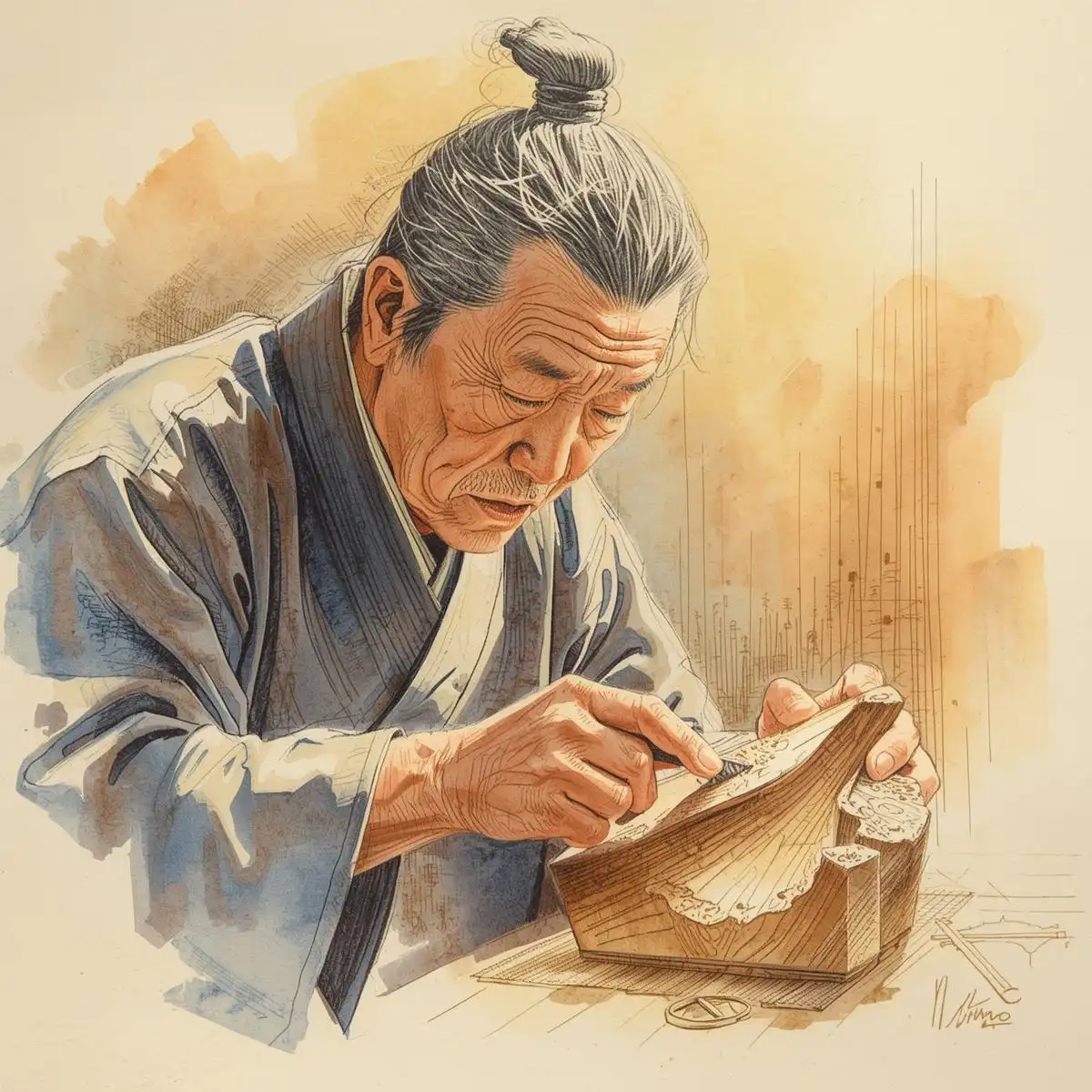
Mokjogakjang–The Korean Art of Wood Carving
At the Origins of a Sacred Art
For centuries, wood has held a central place in the architecture, art, and spirituality of the Korean peninsula. Present in temples, traditional houses (hanok), and ritual objects, it has shaped the aesthetics and cultural landscape of the country.
It was during the Three Kingdoms period (삼국시대) that Mokjogakjang (목조각장), the Korean art of wood carving, wasborn. Its development intensified with the rise of Buddhism, particularly under the Silla kingdom (신라). In 528, King Beopheung (법흥왕) proclaimed Buddhism as the state religion, paving the way for the construction of grand temples and the production of sacred images.
While the earliest Buddhist statues were made of stone or bronze, wood gradually became the preferred material. Lighter, more accessible, and warmer in expression, it allowed sacred figures to be embodied with particular sensitivity. Under the hands of sculptors, it became a medium of devotion and a vessel of spirituality.
Over the centuries, political and religious transformations altered the status of this art. Under the Joseon Dynasty (조선), Neo-Confucianism marginalised Buddhism. Invasions, the Korean War, and rapid urbanisation in the 20th century led to the disappearance of many forests and traditional workshops. Korea, once shaped by wood, gradually became a landscape of concrete and glass.
Despite these upheavals, Mokjogakjang endures — in temples, in specialised workshops, and in the patient transmission from master to student.
A Dialogue Between Hand and Material
Mokjogakjang is not merely a craft technique; it relies on a deep understanding of the material.
Master sculptors use various types of wood — pine, paulownia, ginkgo, zelkova, or blacklocust — chosen for their density, stability, and grain. Before any carving begins, the wood is left to rest for several years to prevent cracks and deformation. This drying phase is essential: the material must stabilise before it can be shaped.
Depending on the size of the work, a single trunk may be used, or several pieces may be precisely assembled to form a harmonious whole. An interior cavity is then carved, not to lighten the sculpture, but to allow the wood to breathe and relieve internal tension.
In Buddhist tradition, this cavity hosts the Bokjang (복장) ritual: sacred texts, talismans, incense, or relics are placed inside before the statue is sealed. The work then becomes consecrated and imbued with spiritual presence.
The sculpture is subsequently covered with layers of lacquer and pigments, sometimes enhanced with gold leaf. Each stage requires slowness, precision, and mastery of gesture. Mokjogakjang is based on adapting the hand to the fibres of the wood—not imposing a form, but revealing the one the material allows.
Masters and Heritage Recognition
On December 31, 1996, Mokjogakjang was officially designated Important Intangible Cultural Heritage No. 108 by the Korean authorities, formally recognising a craft threatened by modernisation.
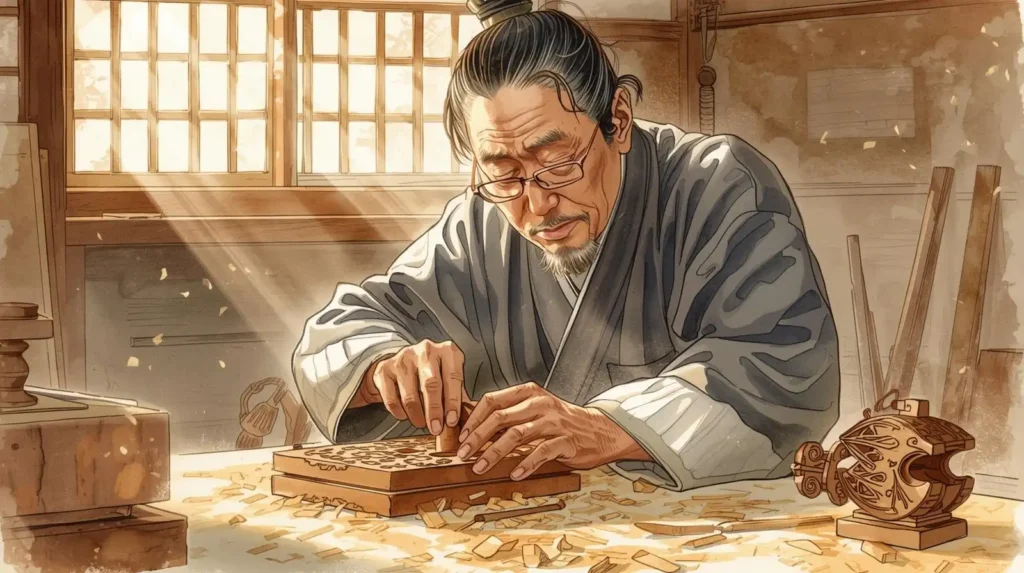
Among the key figures associated with this recognition is Master Park Chan Soo (박찬수), designated 보유자 (Bo-yuja), meaning the official holder and living guardian of this art. His approach combines technical rigour with personal expression. He is particularly known for using a moktak (목탁) — a Buddhist percussion instrument — to strike his chisels, transforming each movement into a controlled rhythm.
Other masters have contributed to the continuity of this tradition, including Jeon Gi Man (전기만), recognised for his sculptures created notably at Haeinsa Temple (해인사), a major site of Korean Buddhism housing the Tripitaka Koreana. His work is distinguished by the stability of posture and the expression of inner serenity.
More recently, artisans such as Lee Bang Ho (이방호) and Kim Kyu Seok (김규석) have expanded the scope of Mokjogakjang, applying its techniques to other forms—notably the production of ritual tteoksal (떡살) moulds used in the preparation of traditional rice cakes. This evolution demonstrates the adaptation of the craft to contemporary contexts without breaking from its foundations.
A Fragile Continuity
Today, the transmission of Mokjogakjang remains demanding. Wood carving requires endurance, precision, and patience — qualities increasingly challenged in a society focused on speed and mass production.
Yet as long as there are workshops, masters, and apprentices willing to dedicate years to mastering the craft, this art will not disappear.
Mokjogakjang is not merely a relic of the past. It is a living memory of the relationship between humans, matter, and the sacred within Korean culture.
This respect for gesture and long-term dedication permeates the first project of Maison Nunchi, Suhoja, where the transmission of craftsmanship becomes a founding principle.